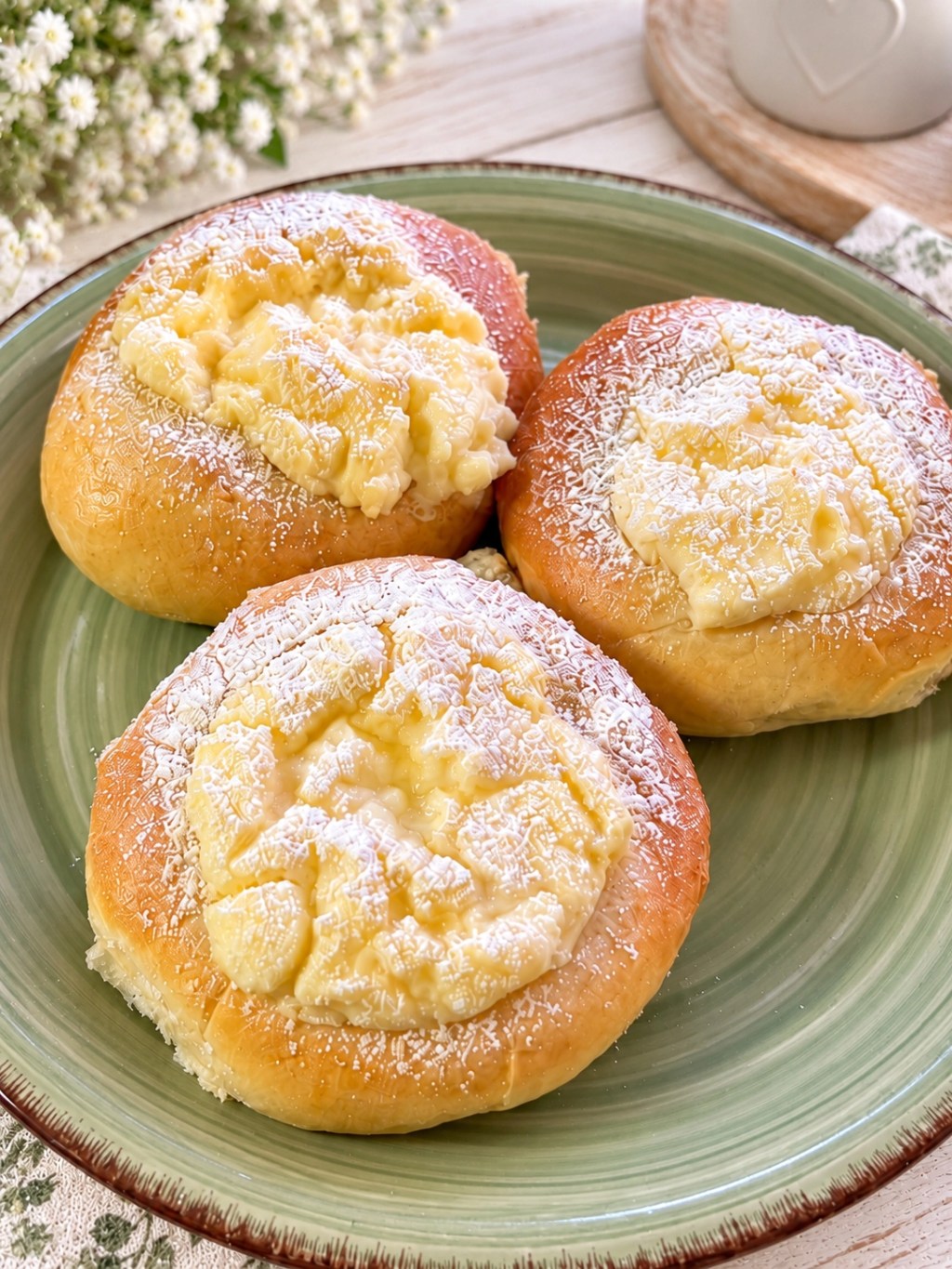
There’s something special about homemade yeast buns. The soft, fluffy dough, the creamy filling and the smell of fresh baking filling the kitchen make them hard to resist. These Polish sweet yeast buns are filled with a delicious mixture of vanilla pudding and Polish farmer’s cheese, creating a soft, creamy centre in every bite.
They remind me of the sweet buns you can find in Polish bakeries. The filling combines thick vanilla pudding made from pudding powder with twaróg, a traditional Polish fresh cheese. The result is creamy, mildly sweet and perfect with a cup of coffee or tea.
This recipe makes 12 generous buns. They take a little time because the yeast dough needs to rise, but the process is straightforward and the result is worth the wait.
Ingredients
For the yeast dough
- 500 g wheat flour (German Type 405)
- 230 ml lukewarm milk, plus a little extra if needed
- 25 g fresh yeast
- 80 g sugar
- 80 g butter, melted and cooled
- 1 large egg
- 1 egg yolk
- 8 g vanilla sugar
- ½ teaspoon salt
For the vanilla pudding and cheese filling
- 400 g Polish farmer’s cheese (twaróg), preferably a firm block
- 1 packet (about 40 g) unsweetened vanilla pudding powder
- 300 ml milk
- 70 g sugar
- 1 egg
- 8 g vanilla sugar
- 1 tablespoon soft butter (optional)
For brushing
- 1 egg
- 1 tablespoon milk
Instructions
1. Prepare the vanilla pudding
Pour about 200 ml of milk into a saucepan and add the sugar. Heat until the milk is hot and the sugar has dissolved.
In a separate bowl, mix the vanilla pudding powder with the remaining 100 ml of cold milk until smooth.
Pour the pudding mixture into the hot milk, stirring continuously. Cook over medium heat until the pudding becomes very thick.
Cover the surface directly with cling film to prevent a skin from forming. Leave it to cool completely before making the filling.
2. Make the cheese filling
Mash the Polish farmer’s cheese with a fork or press it through a sieve to make it smoother.
Add the egg, vanilla sugar and the optional soft butter. Mix well.
Add the completely cooled vanilla pudding and mix until the filling is evenly combined. Refrigerate while preparing the dough.
The filling should be thick enough to hold its shape. If your cheese is particularly wet, drain it before using.
3. Prepare the yeast starter
Crumble the fresh yeast into a small bowl.
Add 1 tablespoon of the sugar, 2 tablespoons of the flour taken from the total amount, and about 100 ml of the lukewarm milk taken from the measured 230 ml.
Mix until smooth and leave for 10–15 minutes, until the mixture becomes foamy.
4. Make the dough
In a large bowl, combine the remaining flour, remaining sugar, vanilla sugar and salt.
Add the yeast starter, egg, egg yolk and most of the remaining milk. Knead for about 5 minutes.
Gradually add the melted butter, making sure it has cooled first. Continue kneading for another 8–10 minutes, until the dough is smooth, elastic and soft.
The dough may feel slightly sticky, which is normal. Add a little extra flour only if it is extremely sticky, and do so one tablespoon at a time. If it feels too firm, add a little of the reserved milk.
5. Let the dough rise
Cover the bowl with a clean kitchen towel or cling film.
Leave the dough in a warm, draught-free place for about 60–90 minutes, or until it has roughly doubled in size.
6. Shape the buns
Gently knead the risen dough for a few moments to release excess air.
Divide it into 12 equal portions and shape each portion into a ball.
Place the balls on a baking tray lined with baking paper, leaving enough space between them. Cover and leave for 15–20 minutes.
Use the bottom of a small glass or another suitable round object to press a deep indentation into the centre of each bun. If the glass sticks, lightly dust its base with flour.
7. Fill the buns
Spoon the vanilla pudding and cheese filling into the indentations. Divide it as evenly as possible between the 12 buns.
Leave the buns to rest for another 10 minutes while the oven heats up.
8. Brush and bake
Preheat the oven to 170°C with fan.
Beat the egg with 1 tablespoon of milk. Carefully brush the exposed dough around the filling, avoiding the filling itself.
Bake for approximately 18–23 minutes, until the buns are lightly golden and cooked through. Baking time may vary depending on your oven, so keep an eye on them towards the end.
9. Cool and serve
Transfer the buns to a wire rack and allow them to cool.
For a softer crust, you can loosely cover the warm buns with a clean kitchen towel for 10–15 minutes.
Enjoy them slightly warm or at room temperature with coffee, tea or a glass of milk.
Recipe Tips
- Use lukewarm milk. Milk that is too hot can damage the yeast and prevent the dough from rising properly.
- Let the pudding cool completely. Warm pudding can make the cheese filling too soft.
- Choose firm twaróg. If the cheese contains too much moisture, the filling may become runny.
- Add the butter gradually. Adding it after the initial kneading helps the dough develop a smooth, elastic texture.
- Do not add too much flour. A slightly soft dough helps produce fluffy buns.
- Make deep indentations. This gives the filling enough room and helps prevent it from overflowing.
- Watch the colour. The buns should be lightly golden rather than deeply browned, which can make the crust harder.
Storage
Because the filling contains cheese and egg, allow the buns to cool and then store them in an airtight container in the refrigerator. They are best enjoyed within 2–3 days.
For the best texture, let a bun sit at room temperature briefly before serving, or warm it gently in the oven.
Can You Freeze These Buns?
Yes. Once completely cooled, place the buns in a freezer-safe container or bag and freeze for up to 2 months for the best quality.
Thaw them in the refrigerator, then let them come closer to room temperature before serving. The filling may have a slightly different texture after freezing, but the buns should still be enjoyable.
Frequently Asked Questions
Can I use instant yeast instead of fresh yeast?
Yes. You can replace 25 g of fresh yeast with approximately 7–8 g of instant dry yeast. Follow the instructions on the packet, as some types can be mixed directly into the flour.
What is Polish twaróg?
Twaróg is a traditional Polish fresh cheese with a firm, slightly crumbly texture. It is often used in cheesecakes, dumplings and sweet pastries. If you cannot find it, choose a firm, well-drained farmer’s cheese or quark with a similar texture.
Is vanilla pudding powder the same as custard powder?
Not necessarily. Vanilla pudding powder used in this recipe is the type commonly sold in Germany and Poland for cooking a thick milk pudding. Custard powder can have a different formulation, so check the package instructions before substituting it.
Why does the pudding need to be completely cold?
If the pudding is still warm, it can soften the cheese mixture too much and make the filling difficult to handle. Cooling it completely helps the filling stay thick.
Why are my yeast buns dense?
The dough may not have risen enough, the milk may have been too hot, or too much flour may have been added. Give the dough enough time to double in size and keep it soft rather than stiff.
Can I prepare the filling in advance?
Yes. You can make the filling a day ahead and keep it covered in the refrigerator. Give it a gentle stir before using it.
Can I make the buns smaller?
Yes. Divide the dough into 16 smaller portions instead of 12. Make sure the indentations are deep enough to hold the filling, and start checking the buns a few minutes earlier, as smaller buns may bake faster.





Leave a Reply