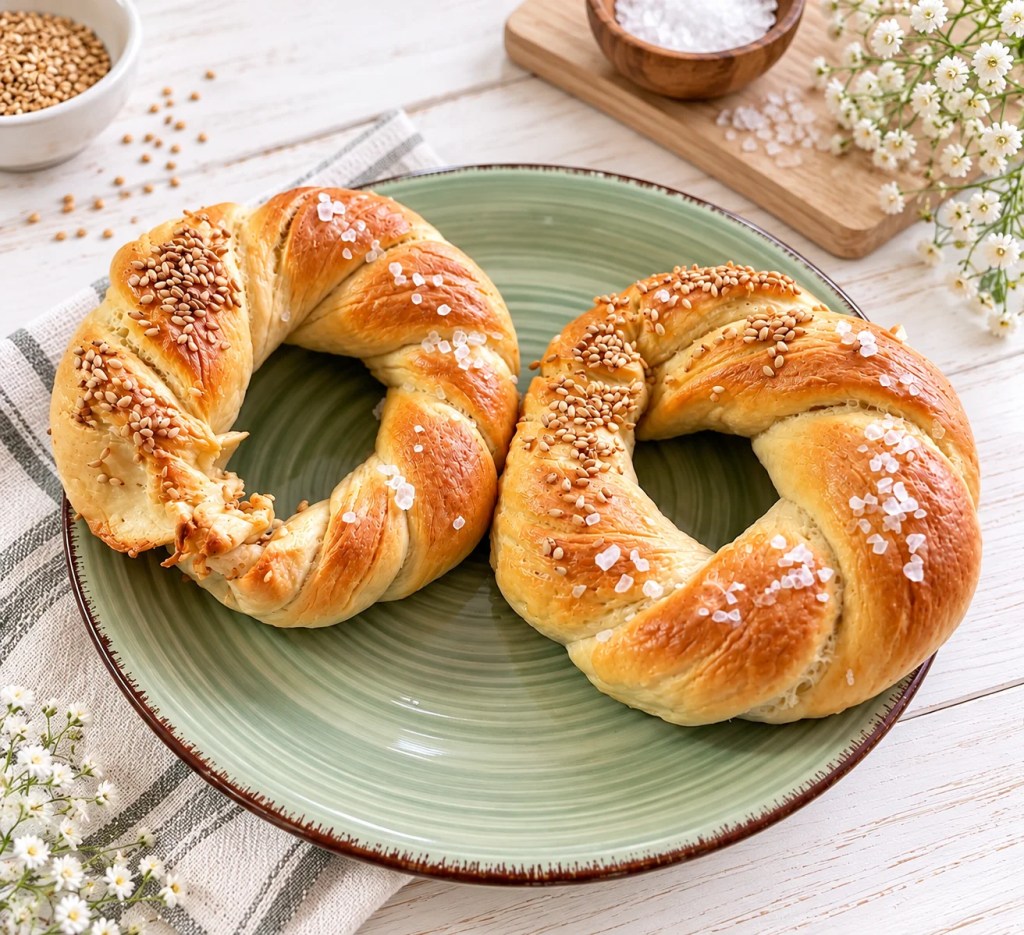
There is something special about homemade bread, especially when it has a soft centre and a lovely, lightly crisp crust. These Polish-style obwarzanki are small twisted bread rings that are briefly boiled before baking, giving them their characteristic texture.
This homemade version makes 8 smaller obwarzanki with a soft inside and a crust that is pleasantly crisp without becoming too hard. I like to top one half with sesame seeds and the other with coarse salt, so everyone can enjoy their favourite topping.
The dough is made with simple ingredients, and the boiling step is much quicker than you might expect. The trick is not to leave the rings in the water for too long and to take them out of the oven as soon as they are nicely golden.
They are delicious while still slightly warm.
Ingredients
For the dough
- 500 g wheat flour (German Type 405)
- 295–305 ml lukewarm water, as needed
- 20 g fresh yeast
- 10 g sugar
- 10 g salt
- 15 g oil
For boiling
- 2–3 litres of water
For the toppings
- Sesame seeds
- Coarse salt
Instructions
1. Prepare the yeast mixture
Crumble the fresh yeast into a small bowl.
Add the sugar and about 100 ml of the lukewarm water, taken from the total amount. Stir until the yeast dissolves.
Leave for approximately 10 minutes, until the mixture starts to look foamy and active.
There is no flour in this yeast mixture. The flour is added directly to the main mixing bowl in the next step.
2. Make the dough
Place the flour and salt in a large bowl. Add the yeast mixture, most of the remaining water and the oil.
Knead for 8–10 minutes, until the dough becomes smooth and elastic.
Start with 295 ml of water in total and add the remaining water gradually if needed. Depending on the flour, you may need the full 305 ml or a little more. The dough should be soft and may feel slightly sticky, but it should not be runny.
Avoid adding extra flour just because the dough sticks slightly to your hands. Too much flour can make the finished obwarzanki harder.
3. Let the dough rise
Shape the dough into a ball and place it in a bowl.
Cover with a lid, cling film or a clean kitchen towel to prevent the surface from drying out.
Leave in a warm, draught-free place for approximately 45–60 minutes, or until the dough has noticeably increased in size.
4. Shape the obwarzanki
Transfer the risen dough to a work surface and divide it into 8 equal portions.
Roll each portion between your hands or on the work surface to make a long rope.
Fold the rope in half, then twist the two strands around each other. Bring the ends together to form a ring and pinch them firmly so the shape stays closed.
Place the shaped rings on the work surface and leave them to rest for about 15 minutes.
5. Briefly boil the rings
Bring 2–3 litres of water to a boil in a large pot, then reduce the heat so the water is gently simmering.
Carefully lower 1–2 obwarzanki into the water at a time. Boil for approximately 15–20 seconds on each side.
Remove them with a slotted spoon and allow the excess water to drain.
Do not boil the obwarzanki for too long. A short boiling time helps create the characteristic crust while keeping the inside soft.
6. Add the toppings
Preheat the oven to 190°C with fan.
Line a baking tray with baking paper and arrange the boiled obwarzanki on it.
Sprinkle sesame seeds over one half of each ring and a little coarse salt over the other half.
Gently press the toppings onto the surface if necessary so they stay in place during baking.
7. Bake
Bake at 190°C with fan for approximately 13–17 minutes, until the obwarzanki are lightly golden.
Start checking them after 12 minutes, as ovens can vary. Remove them once the crust has a nice golden colour. Do not wait until they become very dark, as this can make them too hard.
Transfer the baked obwarzanki to a wire rack and allow them to cool slightly before serving.
Recipe Tips
- Add the water gradually. Different flour brands absorb different amounts of liquid, so the dough may need slightly more or less water.
- Keep the dough soft. A soft dough helps produce a tender centre.
- Seal the ends firmly. This helps the rings keep their shape while boiling and baking.
- Boil briefly. About 15–20 seconds per side is enough for this recipe.
- Watch the oven carefully. The obwarzanki should be golden, not deeply browned, if you want a softer crust.
- Let them cool on a rack. This allows steam to escape and helps prevent the bottoms from becoming damp.
How to Serve Obwarzanki
These homemade bread rings are lovely slightly warm. Enjoy them on their own, serve them with butter or cream cheese, or pair them with your favourite cheese and cold cuts.
The sesame side adds a mild nutty flavour, while the coarse salt gives the other half a simple savoury finish.
Storage
Obwarzanki are best on the day they are baked, when the inside is soft and the crust is at its best.
Once completely cool, store them in a paper bag or a loosely closed bread container at room temperature for up to 1–2 days. A tightly sealed plastic container can soften the crust.
If they become a little firm, warm them briefly in the oven before serving.
Can You Freeze Obwarzanki?
Yes. Allow them to cool completely, then place them in a freezer-safe bag or container and freeze for up to 2 months for the best quality.
Thaw at room temperature and warm briefly in the oven to refresh the crust.
Frequently Asked Questions
What are Polish obwarzanki?
Obwarzanki are ring-shaped breads that are briefly boiled before baking. This process helps give them a distinctive crust and a soft, chewy interior. This recipe is a homemade version designed to make smaller rings with a pleasantly crisp but not overly hard crust.
Why do you boil the dough before baking?
Brief boiling helps set the outside of the dough before it goes into the oven. This contributes to the characteristic texture of boiled-and-baked bread rings.
Why did my obwarzanki turn out too hard?
They may have been baked for too long, boiled for too long, or made with too much flour. Keep the dough soft, follow the short boiling time and begin checking the oven after 12 minutes.
Can I use instant dry yeast instead of fresh yeast?
Yes. Replace 20 g of fresh yeast with approximately 6–7 g of instant dry yeast. Follow the packet instructions for how to add it to the dough.
Can I use a different topping?
Of course. You can use sesame seeds, poppy seeds, coarse salt or a mixture of seeds. Add your chosen toppings after boiling and before baking.
Can I prepare the dough in advance?
For the most predictable results, prepare the dough and bake the obwarzanki on the same day. If you want to work ahead, you can refrigerate the dough after kneading, covered, and allow extra time for it to warm up and rise before shaping.
Why is my dough sticky?
A slightly sticky dough is normal and can produce a softer result. Knead it thoroughly before deciding whether to add more flour. If needed, add a little extra water during kneading rather than making the dough stiff with too much flour.

Leave a Reply