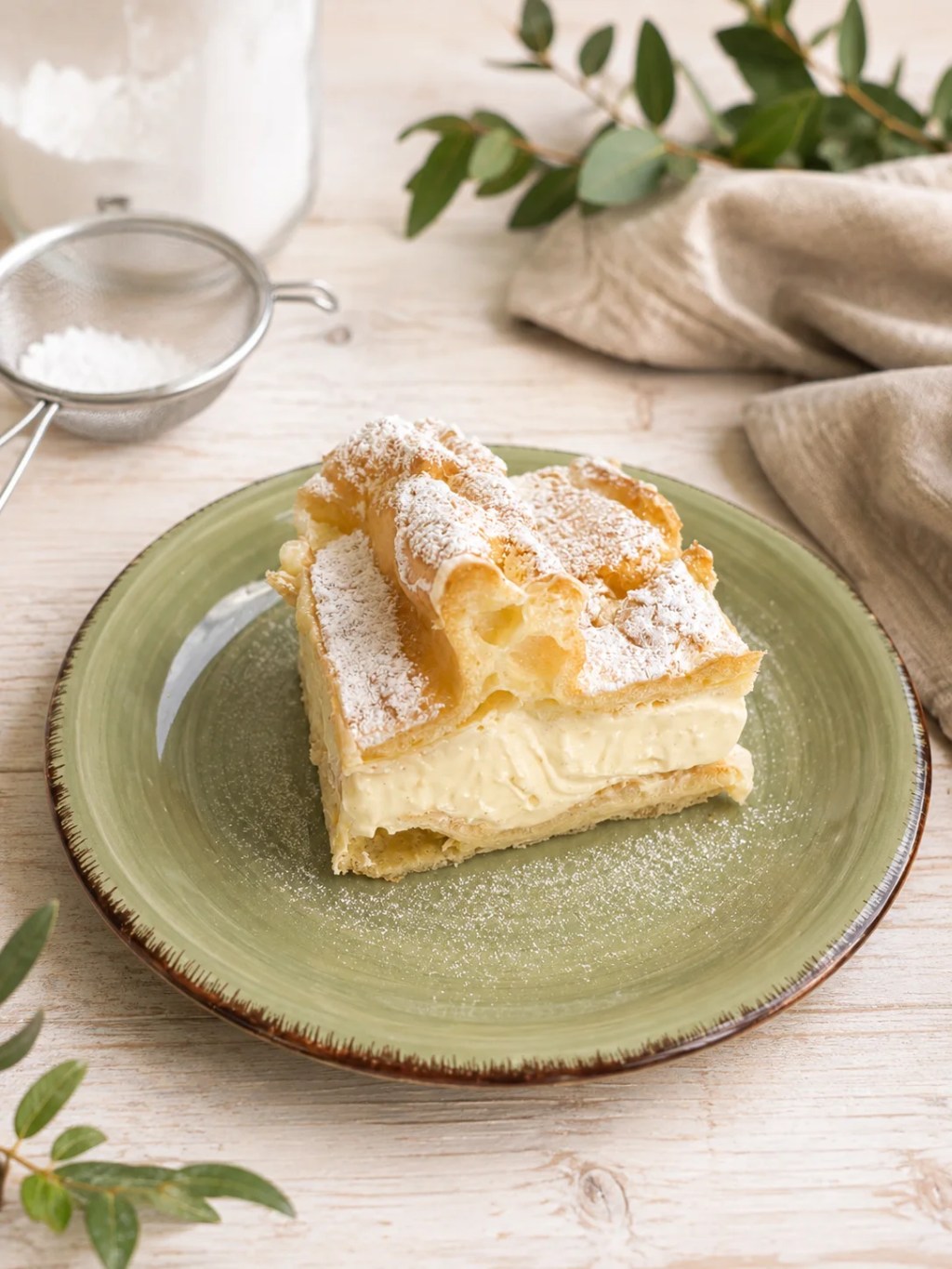
Polish Karpatka is a classic Polish dessert made with two layers of choux pastry and a generous layer of vanilla cream between them. The pastry puffs up into its characteristic uneven, mountain-like shape, which is where the name Karpatka comes from.
This version is a little lighter than many traditional recipes, with a smooth vanilla custard combined with mascarpone and stabilized whipped cream. The result is a soft, delicate cake with plenty of creamy vanilla filling.
It is one of those desserts that looks impressive but is actually quite simple once you break it down into a few steps. 🤍
Why You’ll Love This Recipe
- Light and airy choux pastry
- Generous vanilla cream filling
- Creamy but not overly heavy
- Characteristic “mountain” peaks on top
- Simple ingredients
- Perfect for family gatherings and celebrations
- Even better after chilling overnight
Ingredients
For a 25 × 35 cm (10 × 14 inch) baking pan
Choux Pastry
- 250 ml water
- 125 g unsalted butter
- 160 g all-purpose flour
- 5 eggs
- Pinch of salt
Light Vanilla Cream
- 750 ml milk
- 2 packets vanilla pudding powder, unsweetened
- 70 g granulated sugar
- 1 packet vanilla sugar
- 250 g mascarpone
- 200 ml heavy whipping cream, 30% fat
- 1 packet Sahnesteif
- 1 tablespoon powdered sugar
For Decoration
- Powdered sugar
How to Make Karpatka
1. Make the Choux Pastry
Pour 250 ml water into a saucepan.
Add 125 g butter and a pinch of salt.
Heat until the butter has completely melted and the water comes to a boil.
Remove the saucepan from the heat and add 160 g flour all at once.
Stir vigorously with a wooden spoon until you have a smooth, uniform dough.
Place the saucepan back over low heat and continue stirring for about 1–2 minutes.
The dough should pull away from the sides of the pan and form a compact ball.
Transfer the dough to a mixing bowl and allow it to cool completely.
Once cooled, add the eggs one at a time, mixing thoroughly after each addition.
The finished dough should be thick, sticky and elastic, but still spreadable.
2. Bake the Pastry Layers
Preheat the oven to 200°C (390°F), conventional top and bottom heat.
Line a 25 × 35 cm (10 × 14 inch) baking pan with parchment paper.
Divide the dough into two equal portions.
Spread the first portion evenly over the entire pan.
Don’t try to make the surface perfectly smooth. The uneven surface is what creates the characteristic “mountains” of Karpatka.
Bake for approximately 18–25 minutes, keeping a close eye on it toward the end.
The exact baking time depends on your oven. The pastry should be well risen and golden brown.
Do not open the oven during baking, especially during the first part of the baking time, as the pastry may collapse.
Remove the baked layer from the oven and allow it to cool completely.
Repeat with the second portion of dough.
My Tip
In my oven, the pastry layers were perfectly baked after 18 minutes.
However, ovens vary considerably, so use the color and appearance of the pastry as your guide rather than relying only on the clock.
3. Make the Vanilla Cream
Prepare the Pudding
Pour about 150 ml of the 750 ml milk into a bowl.
Add the 2 packets of vanilla pudding powder and mix until smooth.
Pour the remaining 600 ml milk into a saucepan.
Add 70 g sugar and 1 packet vanilla sugar.
Bring the milk to a boil.
Pour in the pudding mixture while stirring vigorously.
Continue cooking and stirring until the pudding becomes very thick.
Transfer the hot pudding to a bowl.
Cover the surface directly with plastic wrap, pressing it gently against the pudding. This prevents a skin from forming.
Allow the pudding to cool completely.
Whip the Cream
Pour the cold 200 ml heavy cream into a mixing bowl.
Add 1 tablespoon powdered sugar.
Add the entire packet of Sahnesteif.
Whip until the cream is firm and stable.
Set aside.
Combine the Cream
Briefly mix the 250 g mascarpone until smooth.
Briefly mix the completely cooled pudding as well, just until smooth.
Gradually add the pudding to the mascarpone, mixing on low speed until combined.
Finally, gently fold in the whipped cream.
The finished vanilla cream should be smooth, thick and stable.
4. Assemble the Karpatka
Place the first completely cooled pastry layer on a serving tray.
Spread the entire amount of vanilla cream evenly over the pastry.
Place the second pastry layer on top.
Gently press it into place, but don’t crush the characteristic peaks of the pastry.
Loosely cover the cake, making sure the covering does not touch the top layer.
Place the Karpatka in the refrigerator and chill for at least several hours, preferably overnight.
5. Serve
Just before serving, generously dust the top with powdered sugar.
Cut into approximately 12–15 pieces using a sharp knife.
Serve chilled.
Tips for Perfect Karpatka
Let the dough cool before adding the eggs
The choux dough can cool completely before you add the eggs. The important thing is that it is not hot, otherwise the eggs can start to cook.
Don’t open the oven too early
The pastry needs a stable temperature to rise properly. Opening the oven too early can cause the layers to collapse.
Don’t smooth the dough too much
Those uneven peaks are the whole point of Karpatka! A slightly messy surface gives you those beautiful mountain-like shapes.
Baking time depends on your oven
My layers were ready after 18 minutes, but your oven may need longer. Look for a well-risen, golden-brown pastry.
The pudding must be completely cold
Make sure the pudding has cooled completely before combining it with the mascarpone. This is important for getting a stable cream.
Use the whole packet of Sahnesteif
The recipe uses one entire packet of Sahnesteif to help stabilize the whipped cream.
Add powdered sugar just before serving
Don’t dust the cake with powdered sugar before its overnight rest. The sugar can dissolve in the refrigerator.
For the prettiest finish, dust it generously right before serving.
Can I Make Karpatka Ahead of Time?
Yes! In fact, I recommend it.
Karpatka benefits from several hours of chilling because the pastry softens slightly and the cream becomes nicely set.
For the best texture and flavor, prepare it the day before serving and refrigerate overnight.
How to Store Karpatka
Because the cake contains dairy-based cream, keep it refrigerated.
Store it covered in the refrigerator and enjoy within 2–3 days.
Dust with fresh powdered sugar just before serving if needed.
Frequently Asked Questions
Why is it called Karpatka?
The uneven, puffed pastry resembles mountains, which is why the cake is associated with the Carpathian Mountains and is called Karpatka in Polish.
Why did my pastry not rise?
Make sure the dough was cooked properly in the saucepan and that you didn’t open the oven too early. The dough should also be spread unevenly rather than flattened completely smooth.
Can I use vanilla extract instead of vanilla sugar?
Yes. You can replace the packet of vanilla sugar with vanilla extract if you prefer.
Can I use regular whipping cream?
Yes. Use cold heavy whipping cream with around 30% fat or higher. The Sahnesteif helps stabilize it.
Does Karpatka need to be refrigerated?
Yes. Because of the vanilla cream, it should be kept refrigerated.
Can I freeze Karpatka?
I recommend enjoying it fresh rather than freezing the assembled cake, as the texture of the cream can change after thawing.



Leave a Reply